

BRAIN WORMS
The Invisibles (1994–2000) and you
Everything is really about one thing. If it weren’t for the fog of war, you’d know what that thing is. For instance:
The most important thing to understand is that God is a human being. You must understand that God is a specific human being. Don’t weasel your way into airy generalities. You need to see that God is a particular human being, and you need to pick the right one, or your life is wasted. The proof of this claim is its scandalousness. Easy universalisms are a dime a dozen. No other doctrine approaches the singular, shameless particularity of this one.
Granted, it might be more obvious if someone weren’t covering it up. Because he hates you with perfect hatred, and because the surest way to destroy you is to keep you from knowing it, the provisional ruler of this world has contrived innumerable ways of keeping it from you. Because he’s powerful and cunning beyond human understanding, because he’s able to bend your thoughts to his purposes, and because his favorite weapon is the near-truth, you must suspect every stirring of your mind and heart of being a deadly trap.
Because everything is really about one thing, you can find traces of that thing in false religions and philosophies the world over. By all means, read the heathens’ cosmogonic myths and cosmological treatises! They’ll point you in the right direction. Just don’t get distracted. Learn to sift the wheat, to extract the kernel from the shell, to squeeze the juice from the pulp. Remember: the Enemy’s favorite weapon is the near-truth. “Satan himself is transformed into an angel of light.” It’s all a matter of knowing who to trust.
That’s not quite right. Dead wrong, actually. A classic blunder. The most important thing to understand is that God is irreducibly, indivisibly singular. God is eternally and sublimely disincarnate, without child or spouse or peer. All of the major religions, or some of them, used to understand this. God has been diligent about offering reminders, and some of us have been good listeners, but the message always suffers the entropy of history. It gets garbled in the intergenerational game of telephone. You can read their holy books and confirm it for yourself: pristine monotheism is everywhere, except for where it’s not. Where they agree with us, they confirm the primordiality of our doctrine. Where they disagree, they prove their deviance.
The Whisperer—immeasurably cunning, full of bitter jealousy towards us—knows our wandering eye, and he whispers justifications for smuggling in idols both subtle and gross. We’re nudged into the ceaseless invention of avatars and emanations and divine consorts. Hideously baroque pantheons and incarnate deities are a dime a dozen. What I’m trying to say is that the proof of our claim is its scandalousness. Ruthless monotheism is just rare enough to be the truth.
This isn’t to say that it’s a secret. You can reason your way to the core of it, provided you don’t keep reasoning past the point of sense. You can tell your reasoning is sound if it leads you to crisp, austere monotheism. When you catch a glimpse of anything else, you’ll know you’ve gone too far.
It’s all a matter of knowing who to trust. History is a war between those who know and those who don’t.
History is a war, sure, but patriarchal religions are on the wrong side of it. They have been since the first Fertile-Crescent pirate rebranded himself as a landlord. You see it, right? “God the Father,” the “Lord of Hosts”—the cosmos is a manor! A marketing campaign for a system of domination we don’t need to accept.
It matters less and less, though. Centuries of popular struggle have weakened the grip of feudal mystification, but capital is more cunning and adaptable. What the baubles of Axial Age religions once did to order bodies and police desire, the total commodity-form accomplishes without coercion. Every time you pay to watch a piece of mass-market colonial propaganda, you’re volunteering your imagination for capture. The only war that matters is fought on the battleground of your thoughts and desires, and you’re probably sleeping through it
If anything, the enemy has only gotten better at using dissent to its advantage. The infection gets worse when the body tries to expel it, and there’s a word for the virulence of capital under threat: fascism. The pink, swollen reactionaries are right to be furious, and they’re even furious at the right people, but without a veritable theory, they’re cordyceps zombies for capital. It’s all been exhaustively theorized. It’s all a matter of knowing who to trust
No—and it’s telling that you can’t see the irony. There is an international consensus toward which every institution bends, but it’s the program of deracination and subversion. The revolutionaries won. There is no “mass-market colonial propaganda;” these people own Disney! Trust me on this: seeing it for the first time is like waking up from a dream.
Maybe the details don’t matter. If there really is a sinister leviathan looming over history and poisoning the epistemic well, how could you know which leviathan it is? Normal evidence, after all, is inadmissible.
By occult synchronicity, a paperback compendium edition of The Invisibles was released this January, coinciding with the latest Epstein thing. Despite my feverish teenage enthusiasm for Grant Morrison (Xanaduum), I never got around to The Invisibles. This was fortuitous, because its moment is now.
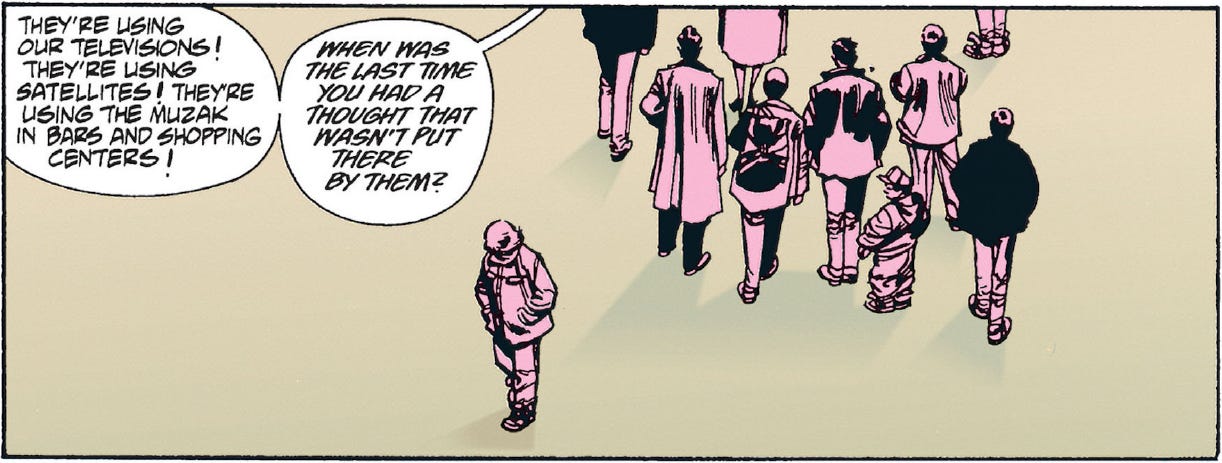
The Invisibles is about the fact that everything is really about one thing. Every institution—the cops, the school board, the record execs, the house of Windsor—is conspiring to squeeze the human species’ vital energy into the mouths of extradimensional demon kings. Every freethinker since at least the 15th century—Lord Byron, Mary and Percy Shelley, the Marquis de Sade, and the series’ cast of anarchist sorcerers among them—has been a participant in an equally sprawling counter-conspiracy. Every bit of intellectual, political, and physical territory on earth is claimed for either riotous liberty or infinite metaphysical tyranny. Every event in history has a final, determinate meaning in light of this conflict. The enemy put crack on the streets. They’ve been hiding an AIDS vaccine since 1978. They put subliminal trigger words in pop records. There may or may not be mind-control implants in the polio vaccine. “Did you know that if you get a map and join up the sites of all the McDonalds restaurants in London, it makes the sigil of the dark emperor Mammon?” “When was the last time you had a thought that wasn’t put there by them?”
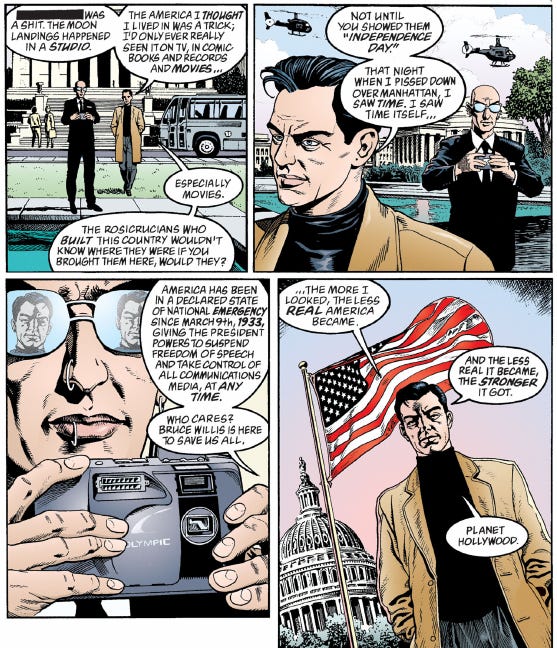
In addition to being outrageously inventive and fun, it’s sophisticated and reflexive: sensitive to the failures of counterculture, revolution, and utopianism, and aware of its own contradictory position as an anti-capitalist commodity. Still, it’s a mostly earnest expression of left-wing paranoid style. I’m old enough to remember when “9/11 truth” was “left-coded,” and I’ve still been floored by how much Tucker Carlson was here, already, in a progressive register. The ideas themselves have more currency than ever, but the inflection has changed completely. Morrison wrote The Invisibles to reinvigorate the counterculture and magically alter the course of the 21st century, but it was too successful and escaped containment. The Invisibles, by means of its influence on The Matrix, is the reason your aunt calls herself “redpilled.” Andrew Tate is King Mob’s dark mirror, abortively summoned from the noosphere and into public life. The Invisibles is about QAnon.
Morrison has made some of these observations directly, but once you’ve given the injunction to disobedience, it seems a bit precious to turn around and say “no, not like that.” Paranoia is a universal solvent, and once you’ve opened the bottle and let it out, you can’t decide what it eats through. Anyway, I don’t think it’s possible to argue rationally for a left-wing politics of paranoia over a right-wing one, any more than it’s possible to argue for Christianity and against Islam, or vice-versa, from first principles. Narratives like these are built from accumulated hunches; sometimes from bewildering and destabilizing personal experiences. Normal evidence is inadmissible.
The Archons of the Outer Church, The Invisibles’ villains, are parasites. They commandeer matter in order to take repulsive, insectoid form in geometric space. Their presence causes humans to break out in cancerous growths. They pollute your thoughts, your dreams, and your appetites. You can be enlisted in their service without your knowledge or consent. The imagery of pollution is everywhere in The Invisibles, and almost everything (cities, language, the future) is a virus.
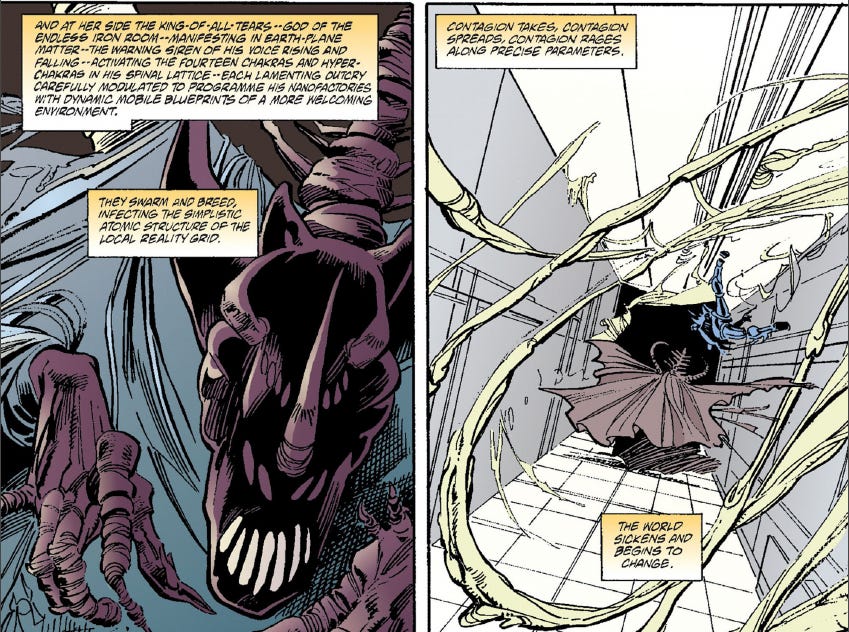
Contamination anxiety might have a special (and explicatory) affinity to conservatism, but it’s also one of the affective bedrocks of culture in general. For much of our history, living in the sublunary world meant, per Charles Taylor, vulnerability to “spirits, demons, cosmic forces,” just as membership in the body politic meant vulnerability to what we would now consider the private thoughts and habits of our neighbors. Taylor:
[W]e ring the church bells when lightning threatens. Or more fundamentally, the whole community turns out in procession to “beat the bounds” of the parish on rogation days. Carrying the host and whatever relics we possess, we march around the boundaries, in this way warding off evil spirits for another season. In one such rite in England, the Gospels were read “in the wide field among the corn and grass, that by virtue of the operation of God’s word, the power of the wicked spirits, which keep in the air and infect the same … may be laid down … to the intent the corn may remain unharmed, and not infected … but serve us for our use and bodily sustenance.”
Our defense here is collective, deploying a power that we can only draw on as a community, on one level, that of the parish, but more broadly that of the Church in its full extent. So we’re all in this together. This has two consequences. First, it puts a tremendous premium on holding to the consensus. Turning “heretic” and rejecting this power, or condemning the practice as idolatrous, is not just a personal matter. Villagers who hold out, or even denounce the common rites, put the efficacy of these rites in danger, and hence pose a menace to everyone.
This is something we constantly tend to forget when we look back condescendingly on the intolerance of earlier ages. As long as the common weal was bound up in collective rites, devotions, allegiances, it couldn’t be seen just as an individual’s own business that he break ranks, even less that he blaspheme or try to desecrate the rite. There was an immense common motivation to bring him back into line.
There’s something curious about the practice of pre-modern religion that I rarely see acknowledged: a gap between formal doctrine and practical habit. As a matter of doctrine, God (the world’s indwelling cause) and the Devil (a mere creature) are fundamentally asymmetrical. In practice, the world was a neutral substrate to be “claimed or counterclaimed,” as the famous Lewis line has it, for good or evil. Friendly supernatural assistance and demonic attack were both forms of foreign occupation. Individual and community life both demanded fastidious spiritual hygiene.
The world of The Invisibles is what “enchantment” looked like. Enchantment was vulnerability, and vulnerability breeds paranoia, and I sincerely believe that conspiracy theory is the purest expression of re-enchantment available to us. The panicked sense that your thinking can be polluted, that trusting the wrong voice can be fatal, recreates the pre-modern affect in a way that no work of high romanticism ever could. This is part of its appeal! Taylor says “the thick emotional boundary between us and the cosmos” is “now lived as a loss.” Conspiracy theory is a powerful remedy.
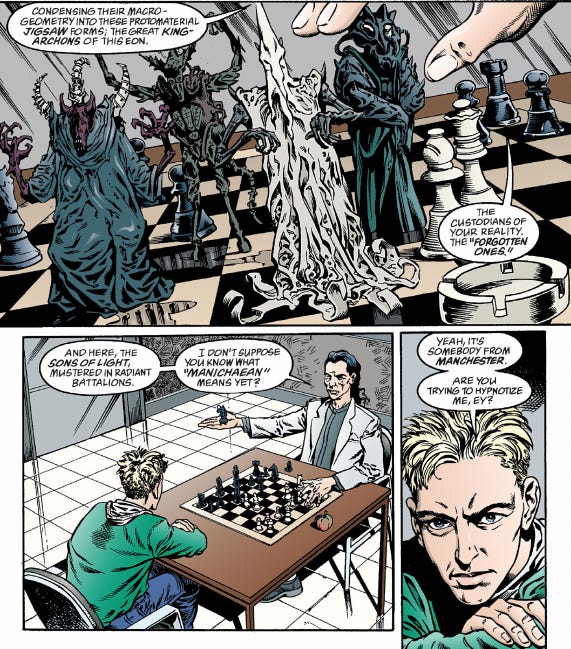
The obvious problem is that it makes you insane. Paranoia might remedy a certain alienation of the spirit, but it’s an autoimmune disorder of the mind. If a sinister superintelligence can plant good arguments to deceive you, and if you can spot these by their conclusions—conclusions foreclosed in advance as heretical—normal evidence is inadmissible. In this light, the buffered self is a monumental immunological achievement. I take this less and less for granted every year. I finally understand that modernity is a miracle.
And yet! I’ll try not to spoil too much (though it would be hard to do so prosaically even if I wanted to), but much of The Invisibles’ paranoid dualism is ultimately subverted. The line between friend and enemy—good conspiracy, that is, or bad—becomes disorientingly blurred as the story reaches its climax, and its villains are finally metabolized rather than exterminated.
From The Invisibles vol. 3, #1:
Larval consciousness experiences the introduction of necessary inoculating agents from the supercontext as a form of invasion by hostile, bacterial forces. The inoculation is conceptualized by the developing larva as an invasion of threatening “not-self” material… the confronting and integration of “not-self” being a necessary stage in the development of the maturing larva’s self-awareness—”philogeny recapitulates history.”
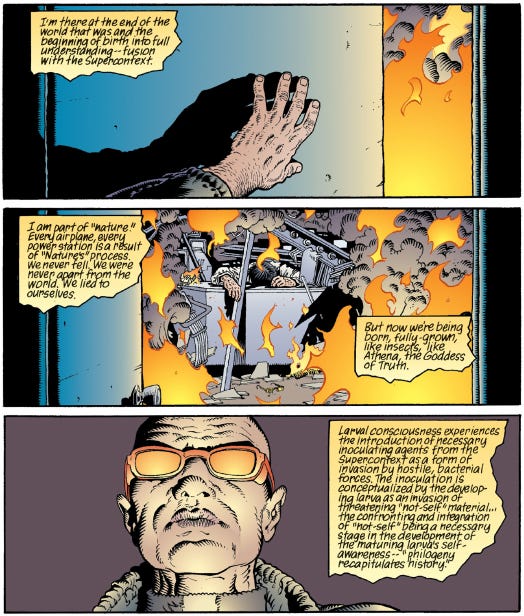
If the “buffered self” has immunological utility to thank for its success, it’s surely telling an incomplete story. We contain the world: an uncountable swarm of other influences, visible and invisible. Your friends, your family, and your “generalized other” are exerting a constant, constraining pressure on what you can think, say, and imagine. You’re catching your thoughts from them like a disease. Your enemies, for their part, define the contours of your identity. Man is monster-fighting and abyss-gazing and nothing else. Consider the well-established contagious quality of conspiracy thinking itself! You really are vulnerable—compromised!
As I see it, the only alternative to paranoid porosity on the one hand and naive atomism on the other is to overcome the idea of the “neutral substrate” altogether. It’s mutual-constitution all the way down.
What does this mean for evil, though? There are many hideous conspiracies, even if there’s no single conspiracy, and many conflicts with real good guys and bad guys, even if history itself isn’t one of them, and I acknowledge completely that many powerful predators depend upon their entanglement with the order of things to escape justice. Apocalyptic dualism still won’t help. The most eschatological leftists I know—whose enemy is the great leviathan astride history, whose party is the great tradition of resistance—were the least prepared for right-wing counterculture, and the Tuckerites of my acquaintance seem barely conscious of the realignment at all. The promise of terrible clarity is always a blinder.
Your enemies are a part of you, the convex edge of your concave one, and their push is the other side of your pull. I think it’s possible to respond to evil, to fight it, without succumbing to fantasies about what victory would mean. Nobody ever survives their own victory. It’s structurally impossible. Victory turns revolutionary vanguards into conservative establishments. Instead of imagining that our preoccupations could ever serve as a manifesto for the eschaton, it’s crucial to understand the contingent, contextual quality of the roles we play: that one decade’s King Mob is another decade’s Andrew Tate. You can play your role with gravity and know when a scene has ended.
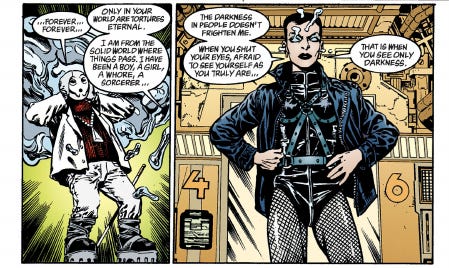
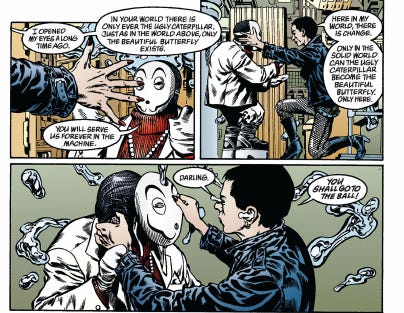
I’m tempted to say that the only way to think clearly about evil is to acknowledge that we wrestle not “against principalities, against powers, against the rulers of the darkness of this world, against spiritual wickedness in high places,” but with “flesh and blood”—with mere flesh and blood, with flesh and blood no different from our own. It happens, however, that this flesh and blood contains the whole world. This is enchantment enough.
Images from The Invisibles (Vertigo, 1994–2000) by Grant Morrison. Art by Steve Yeowell, Phil Jimenez, Jill Thompson, Chris Weston, and others.